
The Values on a Summit County Property Record
One Summit County account can carry several numbers at once. A market estimate, a taxable assessment, and separate land and improvement components all appear in property records maintained by the Assessor. The Assessor's roll exists for tax administration. Deed records from the Recorder add the consideration when a transfer document reports one. Keep the labels straight. A sale is a single event on a single date. The assessed roll is a mass valuation applied across a whole tax year. So treat them as related evidence rather than interchangeable figures.
| Value | What It Is | Where |
|---|---|---|
| Taxable / assessed value | Value carried into the annual property tax calculation after applicable assessment treatment. | Assessor account and tax roll |
| Market estimate | County estimate of full market value for the valuation year, based on the roll’s appraisal process. | Assessor account and assessment map |
| Last sale reference | Reported consideration or transfer clue tied to a recorded conveyance, not a current offer. | Recorder deed index and account history |
| Land / improvement | Separate components assigned to the site and taxable structures or other improvements. | Assessor account and map pop-up |
Utah derives taxable value from the assessed market value under the applicable assessment treatment. The ratio is not uniform. Residential primary-residence treatment can change a taxable figure, so the account's actual lines matter more than any assumption about exemptions. Buyer behavior varies too. A price may reflect timing, condition, personal property, bundled interests, or a transfer that never touched the open market. Before treating any sale as a comparable, compare the stated year, the property type, and the legal description on the parcel.
Read Summit County’s Assessment Map Fields
The County's 2026 Assessment Map offers separate views for single-family residences, condominiums, and commercial property. Clicking a parcel opens a pop-up with market and taxable amounts. It also shows details like area factor, quality, year built, square footage, price per square foot, percentage change, and an RDN field. Treat the map as a first look. Confirm any field in the matching Assessor account. Ask the Assessor when a code or adjustment is unclear.
The property type tab matters. A townhouse may be carried as a condominium. So a user who checks only the single-family view can miss the relevant comparison set. Keep the map's label and date with any notes about a value review.
Open the Summit County 2026 Assessment Map. View the county's property type tabs and valuation context there.
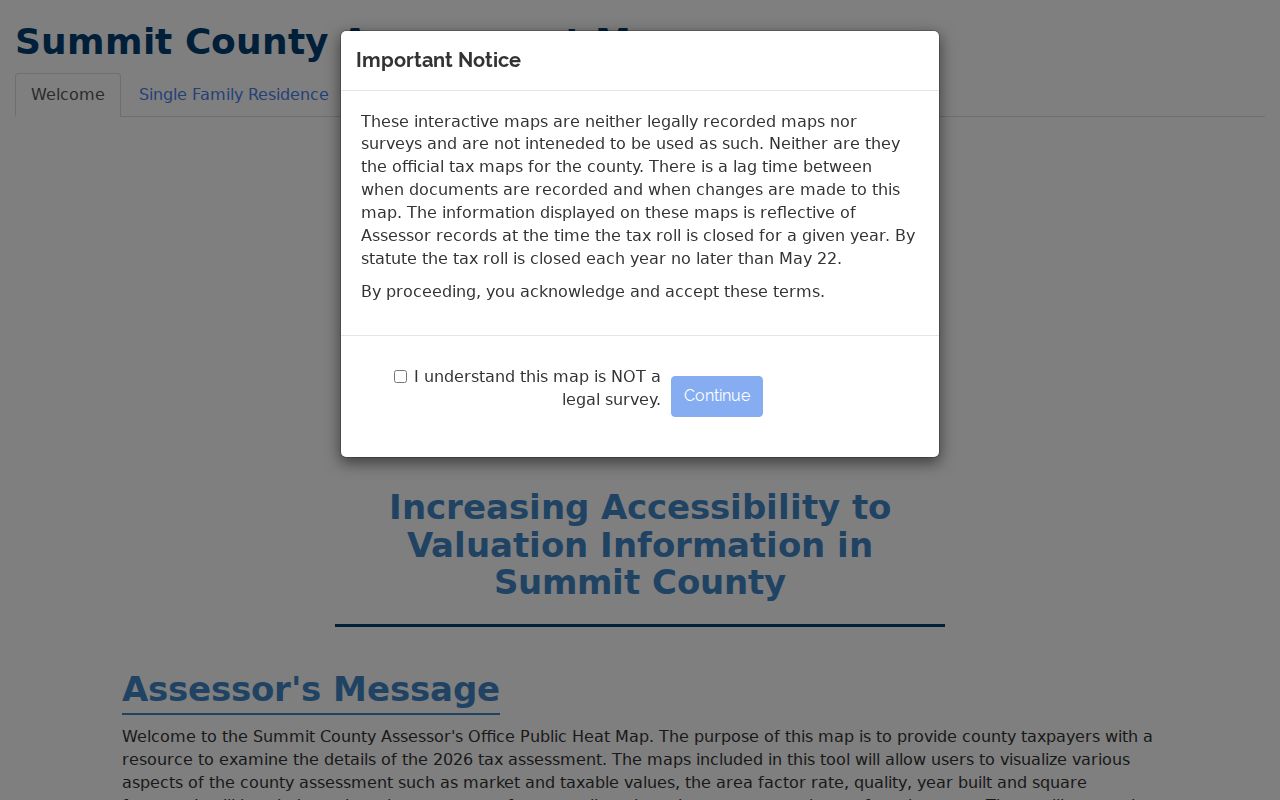
Use the map image as a guide to the interface; verify current values in the live map and Assessor account.
Why a Summit County Roll Value Can Differ from a Sale
The Assessor values many properties for the same roll. It draws on property attributes and market evidence across neighborhoods. It is not an individual inspection and negotiation for one buyer. Quality, living area, year built, location, land characteristics, and property class can all influence the model. A unique view, remodel, deferred maintenance, private access, or unusual legal interest may not be captured. A personal inspection would reveal it.
A recent arm's-length transaction can be useful evidence. But it does not automatically establish the value of another parcel. A comparable should share meaningful traits and a similar effective date. For complex property, a licensed appraiser can inspect the home. The appraiser can explain adjustments that an online roll cannot.
Follow the Annual Summit County Assessment Cycle
Property characteristics and market conditions change over time. The annual assessment cycle can update values even when an owner has not recently sold or improved a property. A value record is therefore a dated public snapshot. Compare one year with another using the same parcel, property class, and field. A change in taxable value may also reflect an exemption or classification change rather than a matching change in market value.
Keep the valuation year beside any assessment-map figure. If a new notice differs from an older account printout, use the current notice. Contact the Assessor about the roll date and appeal instructions instead of relying on an archived screenshot. The Assessor's office can also explain which fields carry forward each year. It can also explain which are recalculated. That context helps an owner read two printouts side by side without mistaking a reclassification for a market shift.
Looking Up a Summit County Property Value
Keep the valuation year beside any figure pulled from the assessment map. When a new notice conflicts with an older account printout, trust the current notice. Contact the Assessor about the roll date and appeal instructions instead of relying on an archived screenshot of the tax roll.
- Search the Summit County Assessor account by address, owner, or legal description and match the situs and parcel key.
- Read market, taxable, land, and improvement values with their valuation year and property class.
- Check the Recorder’s deed index for a transfer document and reported sale consideration, if available.
- Use the assessment map to compare relevant property characteristics and nearby records, not as an appraisal.
- Assessed value
- The value carried into the tax roll after applicable treatment; check the account for the actual taxable amount.
- Market value
- The Assessor’s estimate of full value for a given roll year, produced for mass appraisal.
- Appraised value
- A professional opinion that may involve inspection, defined assumptions, and a specific purpose.
- Level of assessment
- The relationship between a taxable assessment and market value; an exemption or classification can affect that relationship.
Use a Deed as a Dated Sale Reference
Ownership transfers show up in the recorded deed. Its stated consideration appears when the document reports one. Not every conveyance is an ordinary open-market sale. The county index may describe a transfer without a normalized price suitable for comparison. Read the recording date, grantor, grantee, legal description, and document image before leaning on a sale clue in valuation work.
Older conveyances complicate things. The Recorder's index and the property account can hold different levels of detail. If an online image is unavailable, the Recorder / Surveyor can explain where the document sits. The same office can explain how to get a copy. The Summit County deed records guide walks through the index and the limits on older images.
Prepare Property Value Evidence for an Appeal
Think the Summit County roll got your property wrong? Start by setting the notice beside the property account. Check the physical details it lists. Then build a file for the relevant valuation date. A deed, dated photographs, measurements, permits, and sales of truly comparable parcels all count as evidence. Summit County appeals accept each of them.
One comparison does not work, though. A neighbor's tax bill sitting lower than yours proves nothing. Exemptions and classifications often differ between parcels that look identical.
Watch the calendar. The current valuation notice prints the appeal deadline. It also prints the method the county requires. Last year's form or dates may no longer apply. An appeal targets the assessment record itself. A simple data question can go straight to the Assessor first. Keep copies of everything you file and every response you receive.
Separate Property Value from the Tax Bill
A value record is just one piece of the tax math. Rates, exemptions, special assessments, and taxing entities all shape the final amount due. The entities that levy them matter too. When comparing two Summit County parcels, read each tax account and its bill separately. A higher assessed value alone tells you little about what is actually owed. The property tax records guide covers Treasurer accounts and payment details.
What a Summit County Assessor Value Is Not
The Summit County Assessor's number is a mass-appraisal figure built for tax administration. It is not a broker's asking price. It is not a guaranteed sale number or a lender's collateral conclusion. Nor is it a custom appraisal for one transaction. Even an accurate roll entry can trail a fast-moving market. It can also miss a condition that matters to a buyer. Check the parcel and the date. Bring in a qualified professional when you need a current opinion of property value.
Value vs price. A Summit County assessment is not a promise of what a property will sell for. For a purchase, financing, or other decision that needs a current market opinion, obtain an appraisal suited to that purpose.